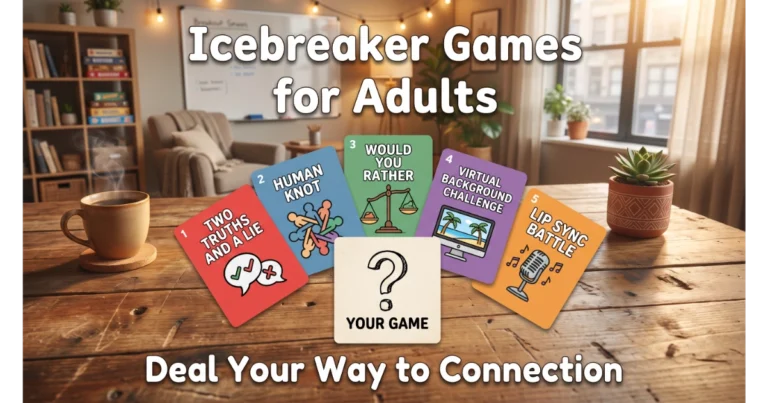
Walking into a silent meeting or virtual call can be painfully awkward. That’s where icebreaker games for adults come in. These simple activities instantly lighten the mood, spark conversations, and help team members connect.
Whether you’re leading a corporate team, managing remote employees, or hosting a workshop, the right icebreaker game transforms stiff sessions into engaging experiences. In this guide, you’ll find 75+ icebreaker games for adults which include quick 5-minute activities to full team-building exercises.
Explore our Would You Rather Questions for Adults for even more conversation starters.
What Are Icebreaker Games and Why Do They Matter?
Icebreaker games are structured activities designed to “break the ice” and encourage people to communicate comfortably. They’re not just for kids or teens, they’re highly effective for adults, professionals, and even large corporate teams.
These icebreaker games for adults serve several purposes:
- Build Rapport: Makes team members feel more comfortable around each other.
- Encourage Participation: Helps quieter employees or students speak up.
- Reduce Stress: Lighthearted games ease tension and anxiety.
- Boost Creativity: Quick challenges and storytelling can inspire innovative thinking.
- Enhance Communication: Team members learn to listen, respond, and collaborate.
Example: During a Monday morning remote meeting, we tried a Fun Icebreaker Games for Adults. Within five minutes, everyone was laughing and sharing fun facts about themselves a perfect way to kick off the week.
Icebreaker Games for Work
Two Truths and a Lie
Time: 10–15 minutes | Group Size: 5–20 people | Setting: In-person or Virtual | Best For: New teams, first meetings
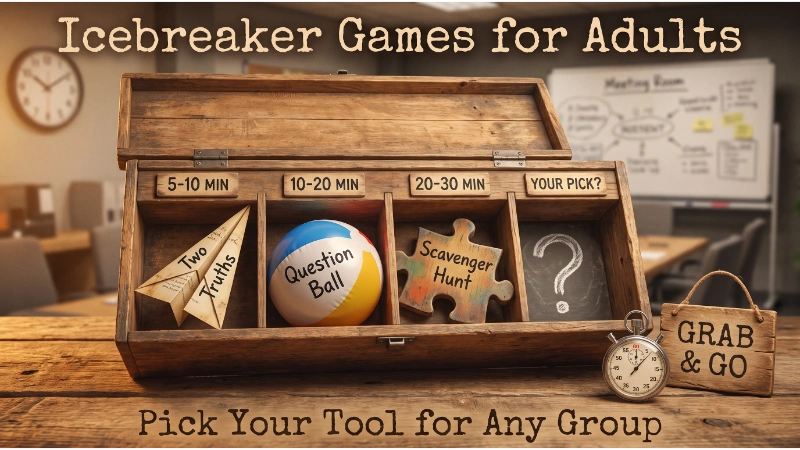
Participants share two true statements and one false statement about themselves. Others guess which is the lie. Reveals surprising facts and sparks conversation naturally.
The Question Ball
Time: 5–10 minutes | Group Size: 6–30 people | Setting: In-person (best) | Best For: Quick warmups, shy groups
Write icebreaker questions on a beach ball. Toss it around — whoever catches it answers the question under their right thumb. Fast, fun, and no one feels put on the spot.
Would You Rather
Time: 10–15 minutes | Group Size: 4–20 people | Setting: In-person or Virtual | Best For: Lightening mood, sparking debate
Pose “Would you rather” questions (e.g., “Work from beach or mountains?”). Participants share their choices. Creates instant conversation without personal pressure.
Office Trivia
Time: 10–15 minutes | Group Size: 6–30 people | Setting: In-person or Virtual | Best For: Company events, reinforcing team knowledge
Prepare trivia about company history, colleagues, or industry. Teams compete to answer correctly. Promotes knowledge sharing while keeping it fun.
Speed Networking
Time: 15–20 minutes | Group Size: 10–40 people | Setting: In-person (best) | Best For: Conferences, new teams, onboarding
Set a timer for 3-minute intervals. Participants introduce themselves to as many colleagues as possible. Fosters new connections quickly.
Envelope Challenge
Time: 10 minutes | Group Size: 6-15 | Setting: In-person | Best For: Work teams
Hand out sealed envelopes, each containing a random prompt like “share a skill nobody knows you have” or “describe your first job in three words.” Everyone opens their envelope at the same time and answers on the spot. The randomness keeps it fresh even for teams who have done every other icebreaker on this list.
Fun Icebreaker Games for Adults
Charades
Time: 15–20 minutes | Group Size: 6–20 people | Setting: In-person or Virtual (with camera) | Best For: Energizing quiet groups, sparking creativity
Participants act out a word or phrase without speaking while others guess. Use themed categories (movies, animals, office items) to tailor to your group.
Pictionary
Time: 15–20 minutes | Group Size: 4–16 people | Setting: In-person or Virtual (digital whiteboard) | Best For: Creative teams, breaking tension
Players draw a word or phrase while teammates guess. Sparks laughter and creativity. Use online whiteboards for virtual teams.
Name That Tune
Time: 10–15 minutes | Group Size: 4–20 people | Setting: In-person or Virtual | Best For: Music lovers, adding energy
Play short song snippets. Participants guess the title or artist. Perfect for energizing any event and appealing to diverse tastes.
Balloon Pop
Time: 10–15 minutes | Group Size: 8–30 people | Setting: In-person only | Best For: High-energy groups, physical activity
Write questions or challenges on paper, insert into balloons, and inflate. Participants pop balloons and complete the challenge inside. Guaranteed laughs.
Lip Sync Battle
Time: 15–25 minutes | Group Size: 6–20 people | Setting: In-person or Virtual | Best For: Ending events on a high note, extroverted groups
Participants choose a song and perform a lip sync. Record and share performances. Brings guaranteed entertainment and memorable moments.
Superpower Question
Time: 5 minutes | Group Size: Any | Setting: In-person or virtual | Best For: Any group
Ask everyone to name one superpower they would want and why. It sounds simple, but the “why” almost always reveals something real about what people value or what they are dealing with that week, which makes it a surprisingly good read on a group.
Bucket List Share
Time: 10 minutes | Group Size: Any | Setting: In-person or virtual | Best For: Any group
Everyone shares one thing on their bucket list, work-related or personal. It works well because it naturally leads to follow-up questions and often uncovers shared interests between people who did not think they had much in common.
Unique Icebreaker Games for Adults
Desert Island
Time: 10–15 minutes | Group Size: 5–15 people | Setting: In-person or Virtual | Best For: Deep conversations, learning priorities
Ask what three items participants would bring to a desert island and why. Sparks interesting discussions about values and priorities.
The Hot Seat
Time: 10–15 minutes | Group Size: 6–20 people | Setting: In-person or Virtual | Best For: Teams that know each other, building trust
One person sits in the “hot seat” while others ask rapid-fire questions for 1 minute. Encourages quick thinking and reveals fun facts.
Who Am I?
Time: 15–20 minutes | Group Size: 6–15 people | Setting: In-person (best) | Best For: Mixed groups, pop culture fans
Place a famous person’s name on each participant’s back. They ask yes/no questions to figure out who they are. Classic and always entertaining.
The Memory Wall
Time: 15–20 minutes | Group Size: 5–20 people | Setting: In-person (best) | Best For: Building emotional connections, nostalgia
Each person shares a favourite memory related to a theme (travel, food, childhood). Write on sticky notes and create a wall. Builds instant connection.
Would You Rather – Adult Edition
Time: 10–15 minutes | Group Size: 4–20 people | Setting: In-person or Virtual | Best For: Adult social events, dinner parties
Pose adult-themed questions (e.g., “Personal chef or personal trainer?”). Sparks engaging conversations without getting too personal.
Icebreaker Games for Large Groups
Human Knot
Time: 15–20 minutes | Group Size: 8–20 people per circle | Setting: In-person only | Best For: Team building, problem-solving
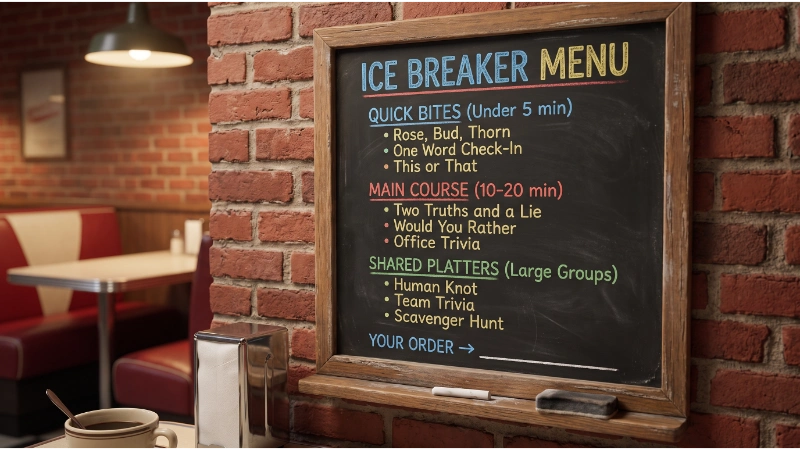
Participants stand in a circle, grab hands with two different people across from them, then untangle without letting go. Encourages teamwork and communication.
Group Juggle
Time: 10–15 minutes | Group Size: 10–30 people | Setting: In-person only | Best For: Energizing large groups, learning names
Toss a ball around, saying the recipient’s name before throwing. Add more balls to increase difficulty. Enhances focus and name recall.
Scavenger Hunt
Time: 20–30 minutes | Group Size: 10–50 people | Setting: In-person or Virtual (photo hunt) | Best For: Team competition, exploration
Create a list of items or clues to find within a set time. Teams compete to find everything. Include photo challenges for extra fun.
Team Trivia
Time: 15–25 minutes | Group Size: 8–40 people | Setting: In-person or Virtual | Best For: Friendly competition, knowledge sharing
Split into teams and ask trivia questions. Use buzzers or online platforms for excitement. Promotes collaboration and friendly rivalry.
Group Storytelling
Time: 10–15 minutes | Group Size: 6–20 people | Setting: In-person or Virtual | Best For: Creativity, humor
One person starts a story with a sentence; each person adds one sentence. Results are often hilarious and creative. Great for ending sessions on a high note.
Problem-Solving Relay
Time: 20 minutes | Group Size: 15+ | Setting: In-person | Best For: Large groups, corporate events
Break into teams and give each team a simple puzzle or riddle to solve before passing a token to the next team member, relay-style, until the whole team has taken a turn. It combines physical movement with light problem-solving, which keeps energy up in a way that pure discussion games do not, especially with larger groups.
Icebreaker Games for Teens
Four Corners
Time: 10–15 minutes | Group Size: 8–30 people | Setting: In-person only | Best For: Quick energy release, movement
Label corners with options (Pizza, Burgers, Tacos, Sushi). Ask a question and participants move to their choice. Gets people moving and talking.
Speed Friending
Time: 15–20 minutes | Group Size: 10–30 people | Setting: In-person (best) | Best For: New schools, camps, youth groups
Similar to speed dating, participants rotate and have short conversations. Helps teens make new friends quickly in a low-pressure setting.
Would You Rather – Teen Edition
Time: 10–15 minutes | Group Size: 4–20 people | Setting: In-person or Virtual | Best For: Sparking discussions, age-appropriate fun
Pose teen-friendly questions (e.g., “Fly or be invisible?”). Sparks lively discussions without getting too serious.
Emoji Storytelling
Time: 10–15 minutes | Group Size: 6–15 people | Setting: In-person or Virtual | Best For: Digital natives, creative expression
Participants use only emojis to tell a story; others guess the narrative. A modern twist on storytelling that’s both fun and challenging.
Talent Show
Time: 20–30 minutes | Group Size: 10–40 people | Setting: In-person or Virtual | Best For: Building confidence, self-expression
Encourage participants to showcase a talent — singing, dancing, or unique tricks. Builds confidence and allows self-expression.
Paper Airplane Contest
Time: 10 minutes | Group Size: Any | Setting: In-person | Best For: Teens, casual groups
Everyone builds a paper airplane and writes one fun fact about themselves on it before flying it across the room. Each person picks up a random plane, reads the fact out loud, and tries to guess whose it is. It gets loud and a little chaotic, which is exactly why teen groups tend to like it.
Best Icebreaker Games
M&M’s Game
Time: 10–15 minutes | Group Size: 5–20 people | Setting: In-person (best) | Best For: Quick sharing, colourful and fun
Pass around M&M’s. Assign a category to each colour (red = hobbies, blue = favourite movies). Participants share based on the colour they pick.
Name Game
Time: 10–15 minutes | Group Size: 6–20 people | Setting: In-person or Virtual | Best For: Learning names, first meetings
Participants introduce themselves with an adjective starting with the same letter as their name (e.g., “Jolly John”). Helps with name recall and adds humour.
The Marshmallow Challenge
Time: 18–20 minutes | Group Size: 8–40 people (teams of 4) | Setting: In-person only | Best For: Innovation, teamwork, creativity
Teams get spaghetti, tape, string, and a marshmallow. Build the tallest structure with the marshmallow on top. Promotes creativity and planning.
Find Someone Who
Time: 10–15 minutes | Group Size: 10–40 people | Setting: In-person (best) | Best For: Large groups, mingling
Create a list of traits (“Has visited Europe,” “Speaks two languages”). Participants find others who match. Gets everyone moving and talking.
Would You Rather – Ultimate Edition
Time: 15–20 minutes | Group Size: 4–20 people | Setting: In-person or Virtual | Best For: Deep conversations, difficult choices
Pose challenging questions (e.g., “Always sing instead of speak, or dance everywhere?”). Sparks deep conversations and reveals personality.
Common Ground
Time: 10 minutes | Group Size: 4-8 per group | Setting: In-person | Best For: Small groups within a larger event
Split into small groups and give each one 5 minutes to find three things every single person in the group has in common, and they cannot be obvious ones like “we all work here.” Groups share their list at the end. This forces actual conversation instead of surface-level small talk.
Icebreaker Games for Small Groups
Table Topics
Time: 15–20 minutes | Group Size: 3–8 people | Setting: In-person or Virtual | Best For: Intimate settings, deep conversations
Provide thought-provoking questions. Each participant picks one and answers. Promotes meaningful discussions in small groups.
The Compliment Game
Time: 5–10 minutes | Group Size: 4–10 people | Setting: In-person or Virtual | Best For: Building positivity, appreciation
Participants give genuine compliments to each other. Fosters positivity and appreciation within the group. Leaves everyone feeling valued.
Never Have I Ever
Time: 10–15 minutes | Group Size: 5–15 people | Setting: In-person or Virtual | Best For: Social settings, revealing shared experiences
Participants share something they’ve never done. Others who have done it raise their hand. Reveals surprising shared experiences.
Silent Meetings
Time: 10–15 minutes | Group Size: 4–12 people | Setting: In-person or Virtual | Best For: Introverts, thoughtful input
Conduct a meeting where all communication is through writing (sticky notes, whiteboards, chat). Encourages thoughtful input and equal participation.
Group Drawing
Time: 10–15 minutes | Group Size: 4–10 people | Setting: In-person (best) | Best For: Creativity, collaboration
One person starts drawing; others add to it. The result is collaborative art. Shows how different perspectives create something unique.
Compliment Circle
Time: 5 minutes | Group Size: 4-10 | Setting: In-person | Best For: Small, familiar groups
Everyone sits in a circle, and each person gives the person to their right one genuine compliment. Keep it moving quickly so nobody has time to overthink it. This one works best for groups who already know each other at least a little, since compliments from total strangers can feel forced.
Bingo Icebreaker Game
Bingo Icebreaker
Time: 15–20 minutes | Group Size: 10–50 people | Setting: In-person or Virtual | Best For: Large groups, mingling, structured interaction
Participants receive bingo cards filled with traits (“Has a pet,” “Speaks two languages”). Mingle to find matches and mark squares. First to complete a row shouts “Bingo!” Offer small prizes for motivation.
Funny Icebreaker Games
Celebrity Impersonations
Time: 15–20 minutes | Group Size: 6–20 people | Setting: In-person or Virtual | Best For: Extroverted groups, guaranteed laughs
Participants choose a celebrity to impersonate; others guess who it is. Brings guaranteed laughter and entertainment.
Funny Faces
Time: 5–10 minutes | Group Size: 4–20 people | Setting: In-person or Virtual | Best For: Quick energy boost, breaking tension
Participants make the funniest faces they can; others rate them 1–10. A lighthearted game that breaks down barriers instantly.
Joke Time
Time: 10–15 minutes | Group Size: 4–20 people | Setting: In-person or Virtual | Best For: Ending sessions, leaving on a high note
Each participant tells their favourite joke. Laughter ensues as everyone shares humour. Keep it workplace-appropriate for professional settings.
Dance Off
Time: 10–15 minutes | Group Size: 6–30 people | Setting: In-person or Virtual | Best For: High energy, physical activity
Play upbeat music and have participants show off their best dance moves. Adds energy and fun to any gathering. No skill required!
Funny Stories
Time: 15–20 minutes | Group Size: 4–15 people | Setting: In-person or Virtual | Best For: Building connection through shared laughter
Participants share their funniest or most embarrassing stories. Fosters connection through shared laughter and vulnerability.
Icebreaker Games for Virtual Teams
Virtual Background Challenge
Time: 5–10 minutes | Group Size: 4–30 people | Setting: Virtual only | Best For: Starting virtual meetings, humour
Participants set creative virtual backgrounds and share them. Sparks conversation and humour in online meetings.
Online Polls
Time: 5 minutes | Group Size: 5–50 people | Setting: Virtual only | Best For: Instant engagement, quick decisions
Use polls to ask fun or thought-provoking questions and discuss results. Instantly engages participants at meeting start.
Digital Escape Room
Time: 30–45 minutes | Group Size: 6–20 people (teams) | Setting: Virtual only | Best For: Team building, problem-solving
Teams solve puzzles and riddles in a virtual escape room. Fosters teamwork and problem-solving skills. Many free options available online.
Virtual Show and Tell
Time: 5–10 minutes | Group Size: 4–20 people | Setting: Virtual only | Best For: Personalising remote interactions
Share an item from your home workspace and tell its story. Personalises remote interactions and reveals personality.
Online Pictionary
Time: 10–15 minutes | Group Size: 4–16 people | Setting: Virtual only | Best For: Creativity, fun breaks
Draw digitally using online whiteboards while others guess. Works well for both large and small virtual teams. Use Skribbl.io or similar tools.
Icebreaker Games for Students
Classroom Bingo
Time: 10–15 minutes | Group Size: 10–40 people | Setting: In-person or Virtual | Best For: First day of school, learning names
Bingo cards contain classroom-related tasks or student facts. Helps students learn names and interests quickly.
Peer Interviews
Time: 10–15 minutes | Group Size: 10–40 people | Setting: In-person or Virtual | Best For: Building communication skills
Students interview a partner and introduce them to the class. Builds communication skills and confidence.
Group Debates
Time: 15–20 minutes | Group Size: 10–30 people | Setting: In-person or Virtual | Best For: Critical thinking, respectful discussion
Organise debates on fun or educational topics. Encourages critical thinking and respectful discussion.
Creative Introductions
Time: 10–15 minutes | Group Size: 10–30 people | Setting: In-person or Virtual | Best For: First day, memorable starts
Students introduce themselves using drawings, acting, or storytelling. Makes the first day memorable and reveals creativity.
Team Challenges
Time: 15–20 minutes | Group Size: 10–40 people (small groups) | Setting: In-person (best) | Best For: Problem-solving, collaboration
Small group challenges like building a tower from straws or solving puzzles. Enhances problem-solving and collaboration skills.
Quick Icebreaker Games (Under 5 Minutes)
Rose, Bud, Thorn
Time: 5 minutes | Group Size: Any | Setting: In-person or virtual | Best For: Work teams Each person shares a “rose” (something good that happened), a “bud” (something they are looking forward to), and a “thorn” (a challenge they are facing). It is a fast way to surface how people are actually doing without a heavy, formal check-in.
One Word Check-In
Time: 2 minutes | Group Size: Any | Setting: In-person or virtual | Best For: Any group Go around and have everyone describe how they are feeling in exactly one word. No explanations, no follow-up unless someone wants to add one. Fast, low-pressure, and works even with groups that do not know each other well.
Desert Island Song
Time: 5 minutes | Group Size: Any | Setting: In-person or virtual | Best For: Any group Ask everyone which one song they would want if they were stuck on a desert island forever. Music opinions tend to get people talking more than most other icebreaker prompts.
Guess the Baby Photo
Time: 10 minutes | Group Size: 6-20 | Setting: In-person | Best For: Office parties, team events Collect a baby photo from each participant ahead of time, display them all, and have everyone guess who is who. Needs a little prep time beforehand, but it is consistently one of the most talked-about activities at any event that uses it.
This or That
Time: 5 minutes | Group Size: Any | Setting: In-person or virtual | Best For: Any group Call out quick paired choices like “coffee or tea” or “beach or mountains,” and have people shout out or hold up their answer. Keep the pace fast. It works as a standalone warm-up or right before a longer icebreaker.
Two Facts, One Lie (Speed Round)
Time: 5 minutes | Group Size: Any | Setting: In-person or virtual | Best For: Teams that already know the classic version A faster version of the classic game: each person gets only 15 seconds to state their three facts, and the group has to guess immediately with no discussion. Good for groups who have played the original so many times that the slow version has lost its spark.
The Alliteration Name Game
Time: 5 minutes | Group Size: Any | Setting: In-person or virtual | Best For: New groups meeting for the first time Each person introduces themselves with an adjective that starts with the same letter as their name, like “Adventurous Alex” or “Bold Brianna.” Simple, memorable, and genuinely helps people remember names afterward.
Show and Tell Lite
Time: 5 minutes | Group Size: Any | Setting: In-person or virtual | Best For: Remote teams Ask everyone to grab one object near them right now and share why it matters to them. Works especially well on video calls since everyone already has their own stuff within arm’s reach.
Weather Report Check-In
Time: 3 minutes | Group Size: Any | Setting: In-person or virtual | Best For: Daily or weekly team meetings Have each person describe their current mood as a weather report, like “partly cloudy with a chance of deadlines.” It is a lighthearted way to check in on morale without asking anyone to get too personal.
Highs and Lows
Time: 5 minutes | Group Size: Any | Setting: In-person or virtual | Best For: Recurring team meetings Everyone shares one high and one low from their week. Keep answers short. This works particularly well as a recurring Monday or Friday ritual rather than a one-time activity.
The Gratitude Round
Time: 5 minutes | Group Size: Any | Setting: In-person or virtual | Best For: Any group Go around and have each person share one thing they are grateful for, work-related or not. Simple, but it reliably shifts the energy of a room in a positive direction before a meeting starts.
Emoji Mood Check
Time: 2 minutes | Group Size: Any | Setting: Virtual | Best For: Remote and hybrid teams Ask everyone to drop a single emoji in the chat that captures how they are feeling right now. Works best on video calls since it does not require anyone to speak, which is helpful for larger or newer virtual groups.
Quick Draw Doodle
Time: 5 minutes | Group Size: Any | Setting: In-person or virtual | Best For: Creative teams Give everyone 60 seconds to doodle their current mood, weekend plans, or a random prompt, then hold up or share the drawing. Nobody needs to be good at drawing for this one to work, and that is usually the point.
The Rhyme Time Game
Time: 5 minutes | Group Size: Any | Setting: In-person or virtual | Best For: Casual groups Each person has to introduce themselves with a word that rhymes with their name, real or made up. It forces a little creative thinking and usually gets a few laughs along the way.
Pop Culture Pick
Time: 5 minutes | Group Size: Any | Setting: In-person or virtual | Best For: Mixed-age groups Ask a quick pop culture question like “what is the last show you binged” or “worst movie you have ever paid to see.” Low effort, high engagement, and it naturally shows generational or cultural differences in the group.
The Would You Rather Lightning Round
Time: 5 minutes | Group Size: Any | Setting: In-person or virtual | Best For: Groups familiar with the standard version Fire off five would-you-rather questions back to back with no discussion, just quick answers. A faster companion to the full Would You Rather game already on this list, built for when time is genuinely tight.
The One Minute Interview
Time: 5 minutes | Group Size: Any, works best in pairs | Setting: In-person or virtual | Best For: New teams Pair people up and give each person exactly one minute to interview their partner, then have them introduce their partner to the group. Works especially well for brand new teams who do not know each other’s names yet.
Expert Tips for Effective Icebreakers
Follow these expert tips to make your icebreaker games successful every time:
- Tailor to the Group: Choose activities appropriate for the group’s size, age, and setting.
- Keep It Inclusive: Ensure activities are accessible and comfortable for all participants.
- Encourage Participation: Create a welcoming environment where everyone feels comfortable joining in.
- Debrief: After the activity, discuss experiences and insights to reinforce connections.
FAQS
Q1. What are icebreaker games for adults?
Icebreaker games for adults are structured activities that are designed specifically to help people connect with each other, communicate more openly, and build trust within a group. Unlike children’s games, adult icebreakers tend to focus on professional networking, meaningful conversation, or shared experiences without ever feeling childish or forced.
Q2. What are the best icebreaker games for large groups?
For large groups of twenty people or more, you should use high energy games like Human Knot, Group Juggle, Scavenger Hunt, Team Trivia, and Ball Toss Questions. You will want to avoid any games that require individual speaking time because those take way too long when you have a big crowd to get through.
Q3. Can icebreaker games for adults work for virtual teams?
Yes, they absolutely can work for virtual teams. Some good virtual icebreakers include the Virtual Background Challenge, Online Polls, Digital Escape Rooms, Online Pictionary, and Virtual Show and Tell. You should keep virtual games under ten minutes to maintain everyone’s attention across the screen.
Q4. What are funny icebreaker games for adults?
Funny adult icebreakers include Lip Sync Battle, Celebrity Impersonations, Joke Time, Dance Off, and sharing Funny Stories with the group. These activities create shared laughter among participants without requiring anyone to disclose anything too personal or uncomfortable.
Q5. How do I choose the right icebreaker game?
You should consider four main factors before picking a game. First, think about your group size because large groups need high participation games that involve everyone at once. Second, consider your setting because virtual games work differently from in person ones. Third, look at the relationship level between participants because strangers usually need activity based games rather than conversation based ones. Fourth, check the time you have available and always have five, fifteen, and thirty minute options ready just in case.
Q6. Is it “icebreaker” or “ice breaker”?
Both spellings are actually correct depending on where you use them. “Icebreaker” written as one word is the traditional form used in professional settings. “Ice breaker” written as two words is more common in casual searches online. You can use both forms naturally throughout your content without worrying too much about it.
Q7. What are good icebreaker activities for adults at work?
Some good workplace icebreakers include Office Trivia, Speed Networking, The Question Ball, and various Problem Solving Challenges. You should keep the time under fifteen minutes and make participation optional for everyone. This helps respect introverts who might not want to be put on the spot in front of coworkers.
Q8. What are quick icebreaker games for adults that take under 5 minutes?
Quick icebreakers that take under five minutes include Online Polls, the Virtual Background Challenge, The Question Ball, Common Ground, and The Superpower Question. These options are perfect for starting meetings because they warm people up without eating too much into your main agenda time.
Conclusion: Transform Your Team with Icebreaker Games
Pick one game from this list and try it at your next meeting or event. You can start with Two Truths and a Lie if you have a small group, or go with Human Knot for larger crowds because both games work every single time without fail.
Pro Tip: Bookmark this page right now so you can find it again later. With over 70 icebreaker games covering just about every situation you might face, you will never run out of creative ways to get people talking and connecting with each other.
Start your next session with an icebreaker and watch your team bond instantly. Explore our Unique Icebreaker Questions to Get to Know Someone