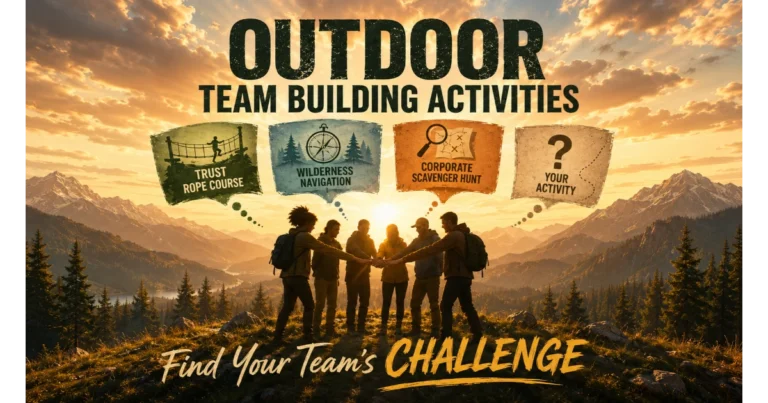
A good outdoor team activity gives people a task they cannot complete well by working alone. The right choice depends on four things: how many people you have, how much time is available, what equipment you can bring, and what you want the group to practice.
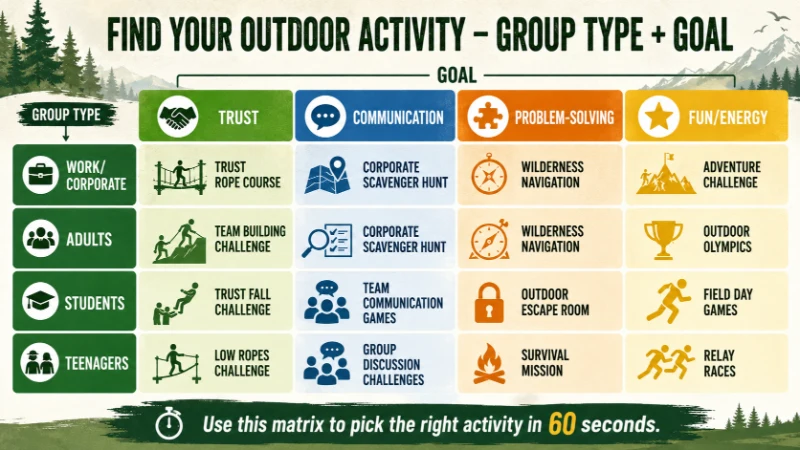
Use the quick-pick table first, then choose from low-setup games, workplace challenges, student activities, adventure formats, and relaxed team-bonding ideas.
Quick-Pick Outdoor Team Building Activities
Use this table when you need an activity quickly. Group sizes are suggested ranges rather than hard limits, so adjust teams and stations to fit your event.
| Activity | Best For | Suggested Group Size | Time | Equipment |
|---|---|---|---|---|
| Human Knot | Communication | 8–16 | 10–15 min | None |
| Shrinking Island | Cooperation | 6–15 | 10–15 min | Tarp or blanket |
| Minefield | Trust and listening | 6–20 | 15–20 min | Blindfolds + safe objects |
| Corporate Scavenger Hunt | Work teams | 8–100+ | 45–90 min | Clue sheet or phones |
| Leadership Rotation Challenge | Leadership | 8–30 | 30–45 min | Task cards |
| Timed Build Challenge | Students and teens | 6–30 | 30–45 min | Simple building materials |
| Outdoor Film Crew Challenge | Teenagers | 6–30 | 45–60 min | Phones |
| Wilderness Navigation Challenge | Adventure groups | 8–30 | 60–120 min | Maps + compasses |
| Team Hiking Challenge | Longer bonding | 6–30 | 2–4 hr | Route + task cards |
| Low Ropes Course | Trust | 8–30 | 60–120 min | Facilitated course |
| Volunteer Cleanup Project | Purpose and bonding | 8–100+ | 60–180 min | Gloves + bags |
| Picnic Challenge Circuit | Relaxed groups | 8–50 | 45–90 min | Simple game supplies |
Planning for 30 or more people? Our team building activities for large groups guide covers formats that scale without leaving half the group waiting for a turn.
Outdoor Team Building Games With Little Setup
These games work when you have a park, field, school ground, or open area but do not want to spend half the session setting up equipment. They are best for short sessions, warm-ups, field days, and groups that need to start moving quickly.
1. Human Knot
Best for: Communication and group problem-solving
Suggested group size: 8–16
Time: 10–15 minutes
Equipment: None
Stand in a circle. Each person reaches across and takes the hands of two different people. Without releasing hands, the group has to untangle itself into a circle or open chain.
The useful part is not how fast they finish. Watch who gives instructions, who listens, and whether several people try to lead at once. Debrief by asking what changed when the group stopped reacting individually and started coordinating.
2. Shrinking Island
Best for: Cooperation under pressure
Suggested group size: 6–15
Time: 10–15 minutes
Equipment: Tarp, sheet, or picnic blanket
Place a tarp on the ground and have the full team stand on it. Once everyone fits, fold the tarp to make the usable space smaller. Repeat until the group has to actively plan where people stand and how they support one another.
No one may touch the ground outside the tarp. The challenge becomes harder without adding complicated rules.
3. Minefield
Best for: Listening and precise communication
Suggested group size: 6–20
Time: 15–20 minutes
Equipment: Blindfolds and soft obstacles
Scatter cones, balls, bags, or other safe objects across a marked area. One participant is blindfolded while a partner guides them from the edge using only spoken instructions.
Switch roles after each round. For a harder version, allow only a limited number of instructions. Finish by asking which directions were actually useful and which created confusion.
4. Helium Stick
Best for: Coordination
Suggested group size: 6–12
Time: 10–15 minutes
Equipment: Lightweight pole or long stick
Line the group up on both sides of a lightweight pole. Everyone places one index finger underneath it. The team must lower the pole to the ground while every finger stays in contact.
The activity looks simple until different people begin moving at different speeds. It creates an immediate reason for the group to agree on pace, instructions, and who should coordinate the movement.
5. Capture the Flag
Best for: Strategy and friendly competition
Suggested group size: 12–40
Time: 20–40 minutes
Equipment: Two flags or visible objects
Divide the playing area into two territories and give each team a flag to protect. Teams must defend their own flag while trying to retrieve the other team’s flag and return it safely.
Before starting, agree on boundaries, tagging rules, and what happens after someone is tagged. The planning before the game is as useful as the running because teams have to decide roles and strategy together.
6. Team Relay Circuit
Best for: Energy and coordination
Suggested group size: 12–60
Time: 20–40 minutes
Equipment: Cones and simple station materials
Instead of one basic relay race, create four or five short stations. One might require a balance task, another a three-person carry, another a puzzle, and another a simple sprint.
The team does not move to the next station until every member has contributed. That keeps the fastest participant from doing everything and makes the event more about coordination than athletic ability.
7. Silent Line-Up
Best for: Nonverbal communication
Suggested group size: 8–40
Time: 10 minutes
Equipment: None
Ask the group to line up by birthday, height, years at the organization, or another category without speaking.
They may gesture but cannot write the answer or use a phone. Once the line is complete, check the order together. It is a quick way to show how much information a group normally relies on speech to communicate.
Outdoor Team Building Activities for Work & Corporate Groups
Workplace activities are more useful when the task requires the same behaviors teams need back at work: clear handoffs, shared decisions, leadership, problem-solving, and coordination. These options fit company offsites, retreat days, department events, and outdoor sessions near the office.
8. Corporate Scavenger Hunt
Best for: Cross-team communication
Suggested group size: 8–100+
Time: 45–90 minutes
Equipment: Clues, task sheet, or phones
Split employees into small teams and give each group a list of clues, photo tasks, company-trivia prompts, or location challenges.
Design the tasks so no one person can solve the entire hunt alone. One clue might need local knowledge, another creative thinking, and another a group photograph. Award points rather than making speed the only way to win.
9. Outdoor Escape Challenge
Best for: Problem-solving
Suggested group size: 6–30
Time: 45–60 minutes
Equipment: Puzzle envelopes, locks, clues
Set up a sequence of puzzles around a park, courtyard, or garden. Each answer reveals the location or code for the next challenge.
Give each team the same puzzle set and a fixed deadline. The activity works best when clues require different skills, such as logic, observation, wordplay, and simple physical tasks.
10. Leadership Rotation Challenge
Best for: Leadership development
Suggested group size: 8–30
Time: 30–45 minutes
Equipment: Task cards
Create four short team challenges. Assign a different leader for each round.
The leader has two minutes to understand the task, organize the group, and get started. When the next round begins, someone else takes over. Debrief by comparing which leadership approaches helped the team move and which slowed it down.
11. Cardboard Boat Build
Best for: Planning and execution
Suggested group size: 8–30
Time: 60–90 minutes
Equipment: Cardboard, tape, scissors, safe testing area
Give teams the same amount of cardboard and tape and ask them to build a small boat or floating structure.
You do not need to put a person inside it. A safer version is to test how much weight each design can hold before taking on water. Teams must divide design, construction, testing, and presentation roles.
12. Outdoor Innovation Sprint
Best for: Creative problem-solving
Suggested group size: 6–30
Time: 45–60 minutes
Equipment: Paper, markers, basic craft supplies
Give each team one real but low-risk challenge, such as improving an onboarding experience, redesigning a shared workspace, or creating a new customer-event idea.
Teams have 30 minutes to develop one solution and five minutes to present it. The outdoor location changes the setting, but the teamwork comes from having to agree on one idea under a deadline.
13. Volunteer Cleanup Project
Best for: Purpose and shared effort
Suggested group size: 8–100+
Time: 60–180 minutes
Equipment: Gloves, bags, approved cleanup equipment
Organize a park, beach, trail, or community cleanup with permission from the relevant location.
Divide responsibilities before starting so teams handle different zones, sorting tasks, logistics, and final checks. Finish with a short review of what the group accomplished together rather than turning the day into a competition.
Need indoor or virtual options as well? Our fun team building activities for work guide covers workplace activities beyond the outdoor setting.
Outdoor Team Building Activities for Students & Teenagers
Students and teenagers usually respond better when the task gives them something concrete to build, solve, film, navigate, or defend. Keep instructions short, give every participant a role, and make the challenge clear enough that the group can start without a long lecture.
14. Timed Build Challenge
Best for: Planning and collaboration
Suggested group size: 6–30
Time: 30–45 minutes
Equipment: Cardboard, tape, string, sticks, or recycled materials
Give each team the same materials and one objective. They might build the tallest freestanding tower, a bridge that holds a small weight, or a shelter that stays upright.
Set a fixed planning period before construction starts. That prevents the loudest student from grabbing the materials immediately and gives the group time to agree on an approach.
15. Group Treasure Hunt
Best for: Communication and problem-solving
Suggested group size: 8–40
Time: 30–60 minutes
Equipment: Clues and markers
Hide a sequence of clues around school grounds, a camp, or a park. Each clue should require the team to solve something before moving on.
Mix observation, simple puzzles, location clues, and small group tasks. Avoid designing every clue around speed so students with different strengths can contribute.
16. Blindfolded Obstacle Course
Best for: Trust and clear instructions
Suggested group size: 6–20
Time: 20–30 minutes
Equipment: Blindfolds and safe obstacles
Build a simple course on flat ground using cones, hoops, ropes, or other safe markers.
One participant moves through the course blindfolded while a partner gives verbal directions. Keep the route low-risk and supervised. Switch roles so both participants experience giving and receiving instructions.
17. Outdoor Film Crew Challenge
Best for: Creative teamwork
Suggested group size: 6–30
Time: 45–60 minutes
Equipment: Phones
Give each group a theme and ask them to create a 60-second video outdoors.
Assign or let students choose roles such as writer, director, camera operator, performer, and editor. The short deadline forces the group to make decisions quickly and gives quieter students ways to contribute behind the camera.
18. Debate Trail
Best for: Listening and confidence
Suggested group size: 8–30
Time: 30–45 minutes
Equipment: Prompt cards
Create several stations along a short walking route. Each station contains a question or dilemma.
Groups stop, read the prompt, choose positions, discuss for a few minutes, then continue to the next station. Use school, community, ethical, or light pop-culture topics appropriate for the age group.
19. Survival Shelter Challenge
Best for: Planning and role allocation
Suggested group size: 6–24
Time: 45–90 minutes
Equipment: Tarps, rope, poles, or safe natural materials
Ask teams to build a simple freestanding emergency shelter within a marked area.
Set clear rules about what materials may be used and what environmental areas must not be disturbed. Judge the result on teamwork, stability, and explanation of the design rather than appearance alone.
Adventure & Wilderness Team Building Activities
Adventure activities add uncertainty, distance, terrain, or physical coordination to the team task. They need more planning than a park game, but they work well for retreats, leadership programs, youth expeditions, and groups that want a longer shared challenge.
20. Wilderness Navigation Challenge
Best for: Decision-making and leadership
Suggested group size: 8–30
Time: 60–120 minutes
Equipment: Maps, compasses, checkpoint cards
Divide participants into groups of four to six and give each team a route with several checkpoints.
The team must navigate in sequence without relying on one person for every decision. Rotate the map reader or navigator at checkpoints so leadership is shared.
21. Team Hiking Challenge
Best for: Longer-form bonding
Suggested group size: 6–30
Time: 2–4 hours
Equipment: Safe route, water, task cards
Choose a suitable route and add short team tasks at planned stopping points.
A task might be a group photo brief, a navigation question, a memory challenge, or a problem the group has to solve before continuing. The activity should fit the fitness and mobility level of the participants.
22. Kayak or Canoe Relay
Best for: Synchronization and communication
Suggested group size: 8–24
Time: 60–120 minutes
Equipment: Appropriate boats, safety equipment, qualified supervision
Pair participants and create a simple relay or checkpoint course on suitable water.
The team result depends on pairs coordinating their paddling and completing clean handoffs between stages. Use a professional provider or appropriately qualified facilitator for water-based activities.
23. Low Ropes Course
Best for: Trust and cooperation
Suggested group size: 8–30
Time: 60–120 minutes
Equipment: Professionally designed course
Use low-to-ground rope, balance, and crossing elements where participants have to support one another through a sequence of challenges.
Choose a properly managed course and follow the facilitator’s safety instructions. The teamwork value comes from planning movement, spotting teammates, and adapting when the first approach fails.
24. Geocaching Challenge
Best for: Navigation and exploration
Suggested group size: 6–30
Time: 45–120 minutes
Equipment: GPS-enabled phones or GPS devices
Set or choose several geocache-style checkpoints across a safe outdoor area.
Teams receive coordinates or location clues and earn points for reaching checkpoints and completing a small task at each one. For school groups, keep all locations within clearly defined boundaries.
25. Outdoor Adventure Race
Best for: Competitive mixed-skill groups
Suggested group size: 12–50
Time: 90 minutes to half-day
Equipment: Depends on stations
Create a route containing several different team stations rather than making the entire event one physical race.
Combine navigation, simple carrying tasks, puzzles, balance challenges, or clue-solving. Score each station separately so a team can recover after one weak event.
Relaxed Outdoor Team Bonding Activities
Not every outdoor team session needs a rope course or competition. These activities suit groups that want more conversation, creativity, or low-pressure interaction while still giving people something to do together.
26. Picnic Challenge Circuit
Best for: Casual bonding
Suggested group size: 8–50
Time: 45–90 minutes
Equipment: Simple picnic games
Set up three or four short stations around a picnic area. Use activities such as trivia, a light relay, charades, or a cooperative puzzle.
Teams rotate between stations rather than spending the entire session competing in one game. Keep scoring optional if the purpose is social connection.
27. Collaborative Mural
Best for: Creative groups
Suggested group size: 6–30
Time: 45–90 minutes
Equipment: Large canvas or paper, paint or markers
Give the group one theme, such as where the team is going next, what good teamwork looks like, or what the group wants to be known for.
Everyone must contribute something to the same final piece. The challenge is agreeing on a shared design rather than creating separate individual drawings.
28. Nature Photo Challenge
Best for: Observation and creativity
Suggested group size: 6–40
Time: 30–60 minutes
Equipment: Phones or cameras
Give teams a list of photo prompts such as “something that represents trust,” “a natural pattern,” “the whole team reflected somewhere,” or “a photo that tells a story without faces.”
Groups return at a fixed time and explain two or three of their choices.
29. Garden or Tree-Planting Project
Best for: Shared-purpose groups
Suggested group size: 8–50
Time: 60–180 minutes
Equipment: Depends on the approved project
Work with a school, community space, workplace site, or local organization on an approved planting project.
Split the work into preparation, planting, watering, cleanup, and documentation roles. The activity works best when participants can see a clear completed result at the end.
30. Walk-and-Talk Pairs
Best for: New teams and quieter groups
Suggested group size: 6–40
Time: 20–40 minutes
Equipment: None
Pair participants and give them a short walking route plus two or three conversation prompts.
Halfway through, change partners. Prompts can focus on work habits, project lessons, personal interests, or light reflection depending on the group. Finish together and invite volunteers to share something useful they heard rather than something private.
How to Choose the Right Outdoor Team Building Activity
Start with logistics before choosing the activity itself.
| Question | What to Look For |
|---|---|
| How many people are attending? | Make sure everyone can participate at the same time or in parallel teams |
| How much time do you have? | Ten-minute games need a different format from a half-day retreat |
| What is your goal? | Choose trust, communication, creativity, leadership, or relaxed bonding |
| What equipment is available? | Do not choose a setup-heavy activity if you only have a park and 30 minutes |
| How physical can the activity be? | Consider age, mobility, fitness, accessibility, and participant comfort |
| Who is the audience? | Work teams, adults, teenagers, and students respond differently to the same format |
| What happens if weather changes? | Have a sheltered backup or an easy activity you can move indoors |
| Will you debrief afterward? | Leave 5–15 minutes to discuss what helped the team succeed |
A simple rule works well: the activity should make teamwork necessary, not optional. If one confident person can complete the whole challenge while everyone else watches, choose a different format.
FAQs
What are the best outdoor team building activities for work?
Corporate scavenger hunts, outdoor escape challenges, leadership rotation exercises, volunteer projects, and team build challenges are good starting points because the group has to make decisions together. Choose the format based on your objective. A scavenger hunt suits communication and energy, while a leadership rotation works better when you want to observe how different people organize a team.
What outdoor team building activities work for teenagers and high school students?
Timed build challenges, outdoor film projects, treasure hunts, debate trails, and supervised obstacle courses give teenagers a concrete task instead of asking them to “bond.” Keep instructions short, use clear time limits, and give participants different roles so the same students do not dominate every activity.
What are good adventure team building activities?
Navigation challenges, team hikes, kayaking or canoeing, low ropes courses, geocaching, and outdoor adventure races all add real terrain or movement to the teamwork task. Match the activity to the group’s fitness, experience, accessibility needs, and available supervision.
What outdoor team building games need little or no equipment?
Human Knot and Silent Line-Up need no equipment. Helium Stick needs only a lightweight pole, while Shrinking Island needs a tarp or blanket. These formats are useful when you have limited preparation time and access to an open field, courtyard, or park.
What are simple outdoor team building activities for adults?
A short scavenger hunt, walk-and-talk pairs, picnic challenge circuit, nature photo challenge, or volunteer cleanup can all be organized without turning the day into an intensive adventure event. For adult groups, the best choice usually depends more on comfort level and purpose than on age.
How do I run outdoor team building for a large group?
Split the group into smaller teams and choose activities that can happen in parallel. Relay circuits, scavenger hunts, photo challenges, Team Olympics, and multi-station events scale better than activities where one person performs while everyone else waits.
Conclusion: Step Outside to Step Up as a Team
The best outdoor session is not the one with the biggest setup. It is the one that gives every person a clear role, creates a real reason to communicate, and ends with a short debrief. Choose one activity that fits your group, run it well, then ask what helped or hurt the team. That conversation is what carries the experience back into class, work, or the next project.